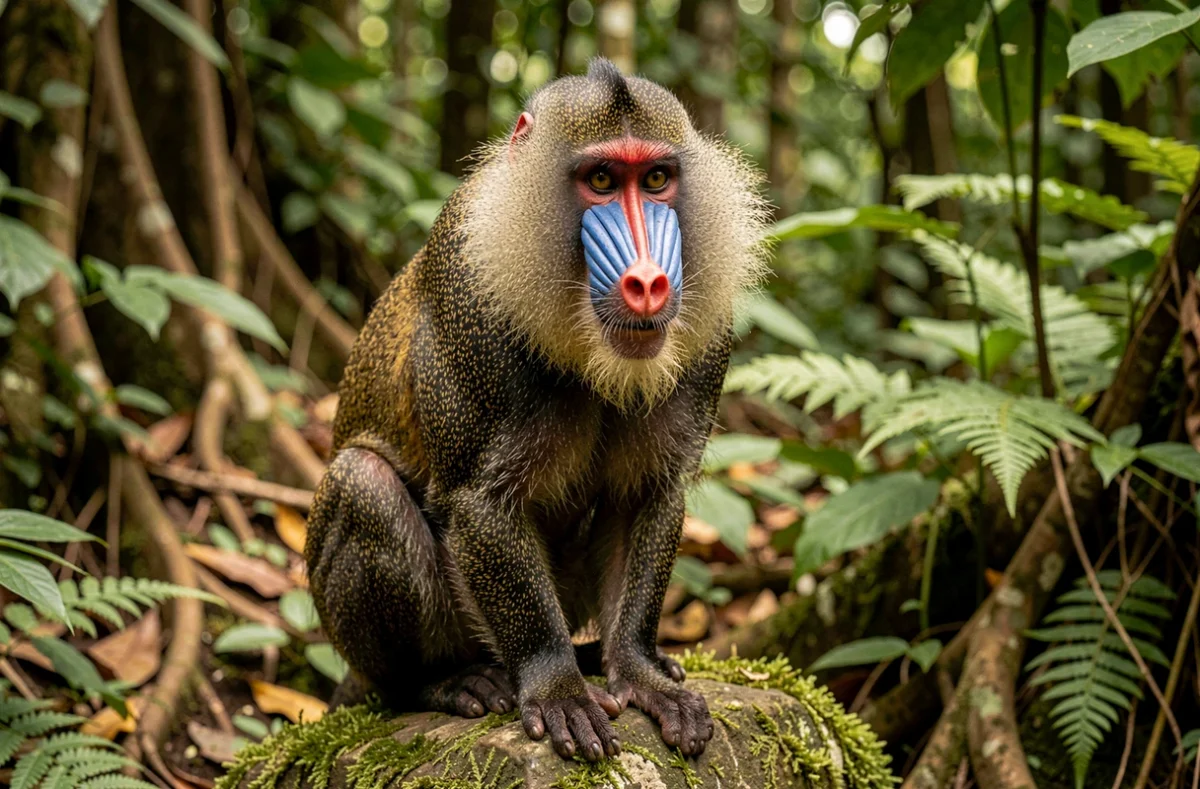
The term “red-bottomed monkey” most often refers to baboons, these African primates whose posterior displays a red, pink, or purplish coloration depending on the species and individuals. This colored area, called ischial callosity, is not just an aesthetic trait. It serves specific biological functions related to reproduction, social communication, and even the health status of the animal.
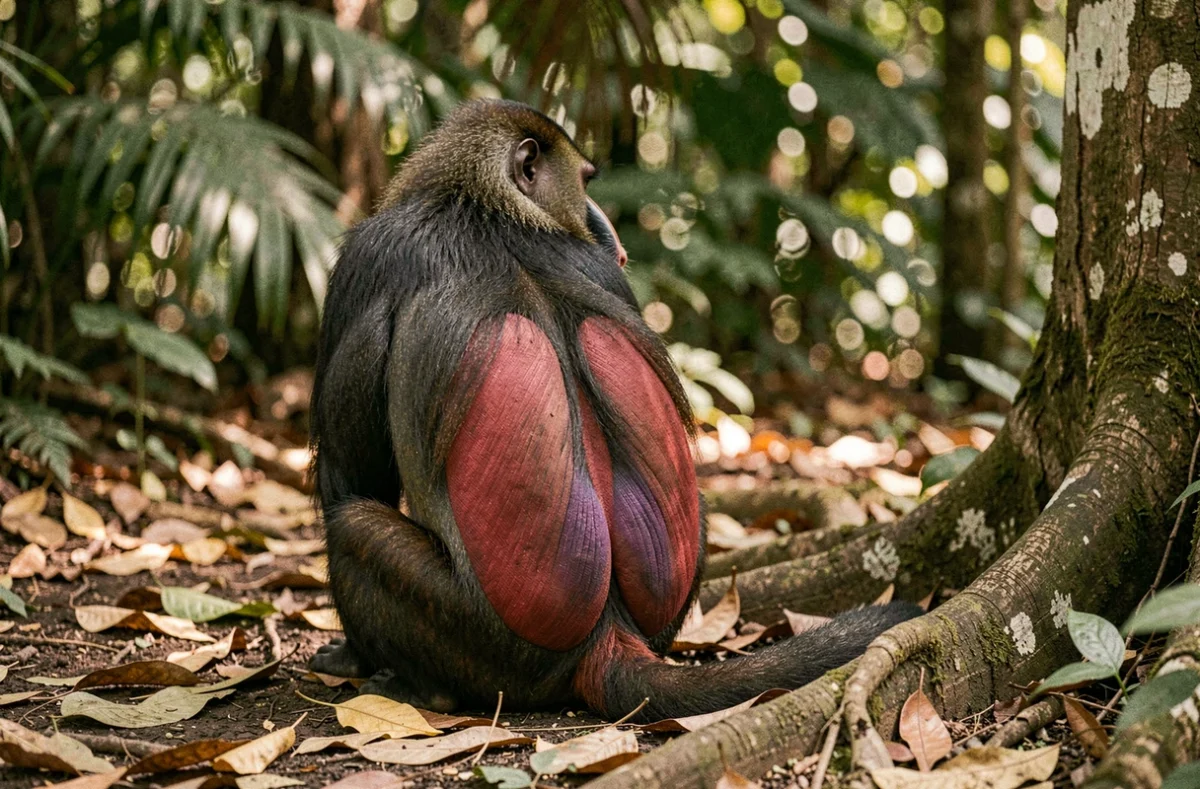
Ischial Callosities: The Mechanics Behind the Red Color of Baboons
The redness of the baboon’s posterior comes from a high vascularization of the perineal skin. The blood vessels, very close to the skin surface in this hairless area, allow the blood to show through due to translucency. The intensity of the color varies according to blood flow, which is influenced by hormones.
In females, swelling and redness peak during the fertility period, due to a rise in estrogen levels. This phenomenon, called perineal tumescence, produces a visual signal that is impossible for the males in the group to ignore.
Males also exhibit colored callosities, but their redness is due to different mechanisms. It may reflect testosterone levels or social status. A dominant male often displays a more pronounced coloration than a subordinate individual. To learn everything about the red-bottomed monkey, it is essential to distinguish what pertains to the reproductive cycle in females and what pertains to hierarchical rank in males.
Vocalizations and Perineal Swelling: A Fertility Signal More Complex Than It Seems
A study published in September 2026 on Guinea baboons analyzed the link between vocalizations emitted during mating and the state of perineal swelling in females. The results indicate that these vocalizations function as a fertility signal indexed to swelling, not as a tool for competition among females.
This distinction is important. The usual reading of “red bottom” tends to reduce the coloration to a passive call to males. Field data nuance this view by showing that the vocal signal accompanies the visual signal in a coordinated manner, without any competition among females to attract attention.
In other words, the reproductive communication of baboons relies on a multimodal system (visual and acoustic) whose components mutually reinforce each other. Females do not “cheat” by exaggerating one signal over the other.
Red Color and Health Status: The Case of the Red-Faced Uakari
Baboons are not the only primates to display an erythematous coloration. The red-faced uakari (Cacajao calvus), a South American monkey, has an intensely red face that serves a different function than that observed in baboons.
In this species, the red color of the face functions as a visible indicator of health status. A healthy individual displays a bright and saturated hue. When the animal is weakened, parasitized, or ill, the coloration noticeably pales.
This mechanism allows peers to visually detect the condition of a group member without physical interaction. Primatologists refer to this as a “skin health barometer.” This logic is rarely discussed in popular content about baboons, even though it opens a line of thought:
- In uakaris, redness signals overall health and resistance to parasites, which guides partner choice
- In female baboons, perineal coloration signals cyclical fertility, with a visual peak linked to estrogen
- In male baboons, coloration reflects more social status and testosterone levels
These three functions (health, fertility, social rank) show that the red color in primates does not have a single meaning. The same visual trait has been recruited by evolution to respond to distinct selection pressures depending on the species.
Social Organization of Baboons: Beyond Aggressive Hierarchy
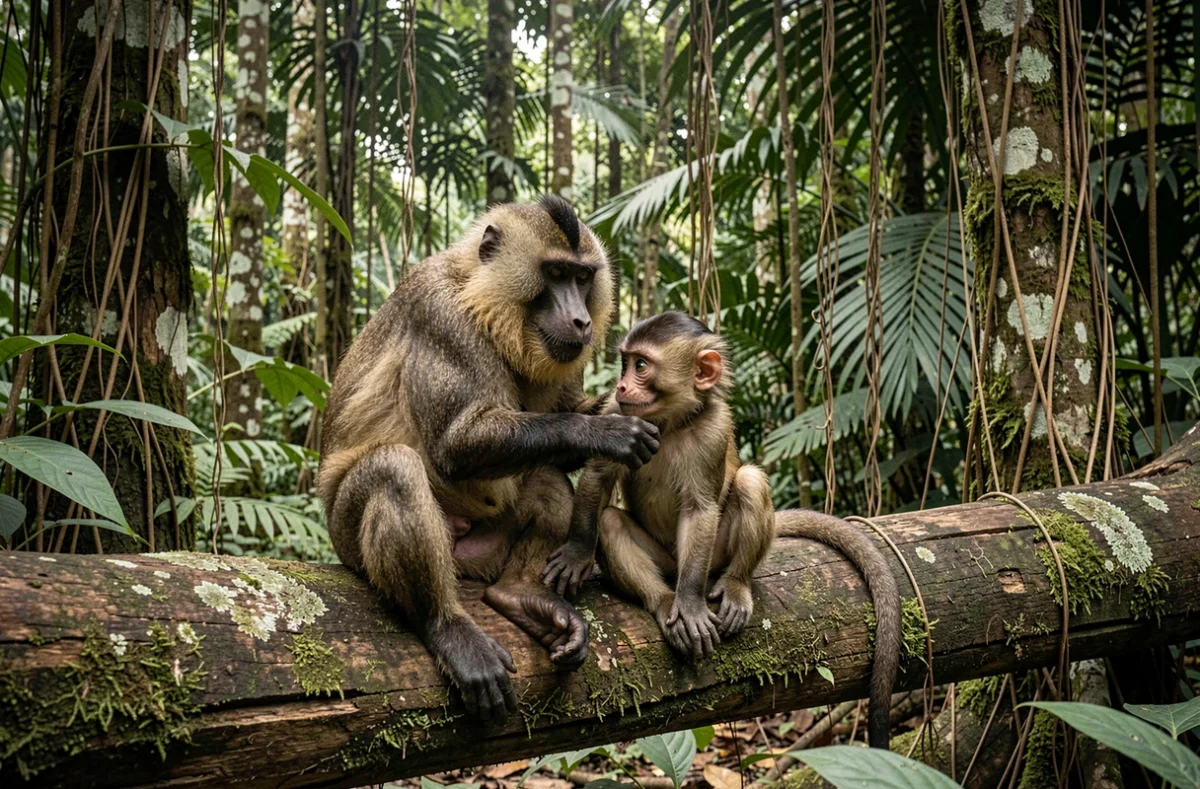
The image of the baboon dominated by aggressive males does not account for the complexity of their social life. The males who are most successful reproductively are not necessarily the most aggressive. The coloration of the posterior, in this context, is just one element among others in a much richer system of social signals, where grooming, proximity, and protection of young play a crucial role.
The management of social tensions in baboons involves varied interactions, which go beyond mere physical confrontation. Perineal coloration is part of this set of visual and behavioral signals that group members constantly interpret.
Climate Pressures and the Future of Colorful Primates
The available data do not allow for precise conclusions about the impact of climate change specifically on baboons. However, recent work on all primates shows that estimates of climate change exceed the rate at which these species can adapt their climatic niche through evolution.
For baboons, relatively adaptable compared to other primates, the main threat remains habitat fragmentation and the reduction of movement corridors. Isolated populations lose genetic diversity, which could ultimately affect the variability of visual signals such as perineal coloration.
The “red-bottomed monkey” fascinates with its appearance, but this appearance is just the surface of a sophisticated communication system, shaped by millions of years of natural selection. The red color in primates tells the story of fertility, health, rank, sometimes all three at once. What seems like an anatomical curiosity is, in reality, a concentration of biological information, readable from a distance by any group member.