
After changing the battery or performing an oil change on a Renault, the engine warning light comes on, and the diagnostic tool shows a code 1525F3. The reflex is to order a sensor or look for a mechanical problem. In most cases, the fault does not come from a defective part but from a step that was overlooked during the intervention.
The engine control unit detects an inconsistency between several signals, switches to limp mode, and the cruise control turns off. Before spending anything, it is essential to understand what triggered this code and which manipulations were neglected.
Lost adaptive values: the real trigger of the Renault code 1525F3
On recent Renault models, the engine control unit continuously stores adaptive values. These data concern injection corrections, the resting position of the throttle body, and idle parameters. They are built up over kilometers to compensate for normal wear of the components.
When the battery is disconnected, even for a few minutes, these adaptive values are erased. The control unit restarts with default parameters that no longer match the actual state of the engine. The CAN network then transmits inconsistent data between the different modules, and the code 1525F3 appears.
You can learn everything about the Renault code 1525f3 by studying the exact conditions of its triggering, but the most common mistake remains confusing a residual fault (related to memory loss) with a real failure of a sensor or the throttle body.
The trap is that erasing the code with the diagnostic tool without allowing the control unit to rebuild its learnings does not solve anything. The fault returns in the next driving cycle, which leads many owners to look for a part to replace when the problem is purely software-related.
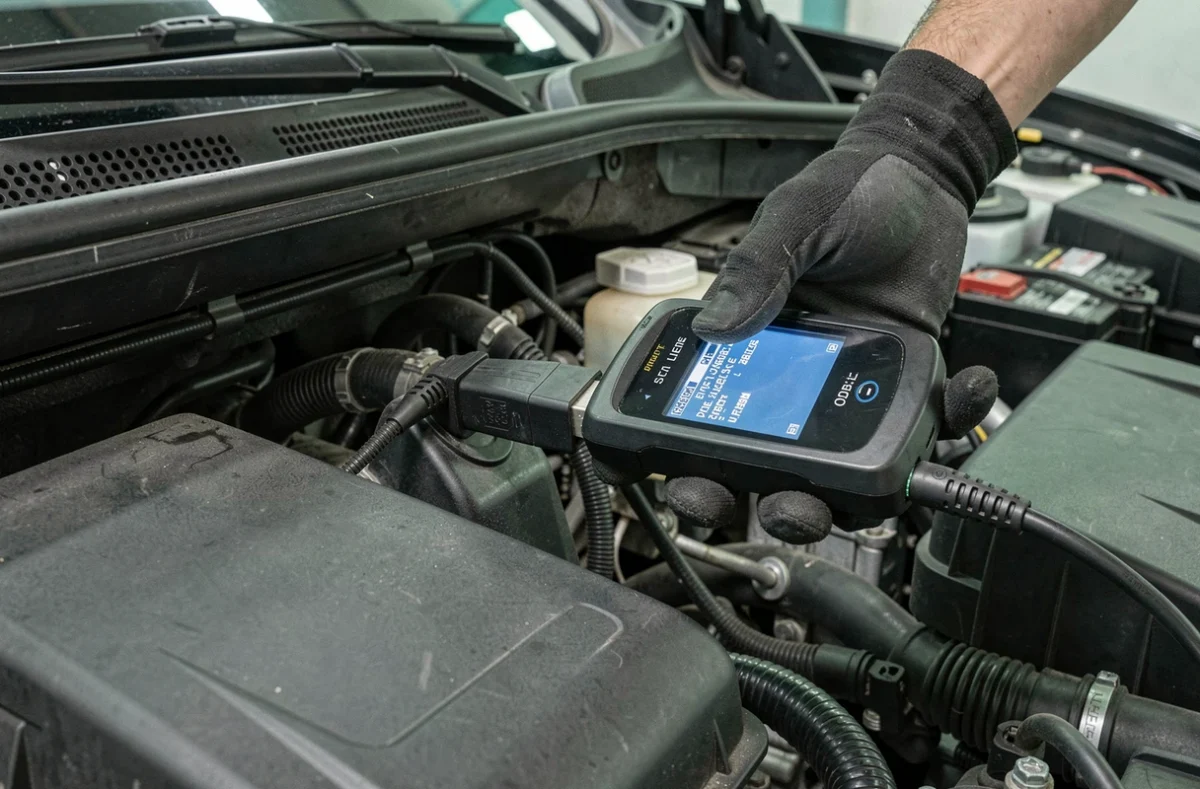
Throttle body relearning after Renault battery disconnection
The electronic throttle body relies entirely on the control unit to know its reference positions. After a power cut, the throttle loses its learned stops. The engine may then exhibit unstable idling, jerking during acceleration, or a lack of response to the pedal.
On some Renault models, the control unit does not automatically regain these positions. The relearning procedure must be manually initiated with a compatible diagnostic tool. Without this step, the system interprets the abnormal behavior of the throttle as an engine fault, and the 1525F3 remains active.
Basic procedure for relearning
- Connect the diagnostic tool, access the injection control unit, and select the throttle body learning function (terminology may vary depending on the tool used).
- Turn on the ignition without starting the engine, and wait for the procedure to complete. The throttle will perform several opening and closing cycles to recalibrate its extreme positions.
- Start the engine and let it idle for several minutes without touching the accelerator, so the control unit can record the new stabilized idle values.
- Take a short drive while varying the RPMs to allow the complete reconstruction of the adaptive injection values.
Feedback varies on this point, but on certain models (Mégane, Scénic, Clio with recent engines), the relearning requires a diagnostic tool. The procedure of turning the ignition off/on sometimes described in forums is not always sufficient.
Engine oil change and code 1525F3: the problem does not come from the oil
After a DIY oil change, the code 1525F3 may appear for reasons unrelated to the oil grade or filter. The classic scenario: a connector is unplugged while working under the hood, a harness is bumped, or a pressure sensor is forgotten to be reconnected.
A poorly connected sensor generates an erratic signal that the control unit interprets as an inconsistency in engine torque. The result is the same code 1525F3, but the cause is purely mechanical, related to the intervention and not to the oil circuit.
Verification points after an oil change
Before launching a complete diagnosis, visually check all accessible connectors around the engine block. The oil pressure sensor, the air flow meter, and the throttle body connector are the three points most often inadvertently moved during an oil change.
The other common mistake concerns resetting the maintenance interval. An oil change and resetting the maintenance counter are two distinct operations. If the reset fails or is not performed, it does not trigger the code 1525F3 by itself, but the confusion between the two alerts leads to searching for a non-existent engine problem.

Differentiating a residual fault from a real failure in Renault diagnostics
Once the checks are done (connectors, throttle relearning, driving phase), one question remains: is the code 1525F3 a residue or a sign of a real problem? The difference is reflected in the fault status on the diagnostic tool.
A fault with a status of “stored” or “past” means that the anomaly was detected but is no longer active. It can be cleared, and then you can drive normally. If the code does not return after a complete driving cycle (cold start, varied driving, stop), the problem is resolved.
A fault with a status of “present” or “permanent” indicates that the control unit still detects the inconsistency in real-time. In this case, further investigation is needed beyond the simple post-intervention procedure: check the voltage of the new battery under load, inspect the CAN network, and examine the components indicated in the diagnostic freeze frame data.
The boundary between the two statuses is what separates a free intervention from a bill for replacing a sensor or throttle body. Taking the time to correctly read the fault status on the diagnostic tool avoids most unnecessary replacements related to code 1525F3.