A boy whose thumbs make flowers grow wherever he places them: this is the starting point of Tistou the Green Thumbs, a tale published by Maurice Druon in 1957. This book aimed at children addresses war, misery, and illness through the eyes of a character who refuses to resign himself to them. Far from a simple wonderful story, the text carries a social critique that several generations of readers have discovered in class or with family.
Maurice Druon and the Philosophical Tale for Children
Maurice Druon is best known for his historical saga The Accursed Kings. Why did an author of medieval political frescoes turn to children’s literature? The tale offered him a different terrain: that of the parable. Tistou the Green Thumbs does not explain the world to children; it questions it through them.
Druon was also a resistance fighter, a winner of the Prix Goncourt, and a minister of Cultural Affairs. This trajectory sheds light on the tone of the book: a tale that blends poetry and political engagement. The child Tistou discovers his parents’ arms factory, the source of the family fortune. He understands that wealth is based on an activity that contributes to the injustices of the world.
From the outset, the book was conceived simultaneously by the writer and the illustrator Jacqueline Duhême. This collaborative work gives the text a visual dimension thought out from the very first page, not added afterward. To deepen this reading, a reading guide on Tistou the Green Thumbs details the narrative construction chapter by chapter.
Tistou the Green Thumbs: Narrative Structure and Themes of the Tale
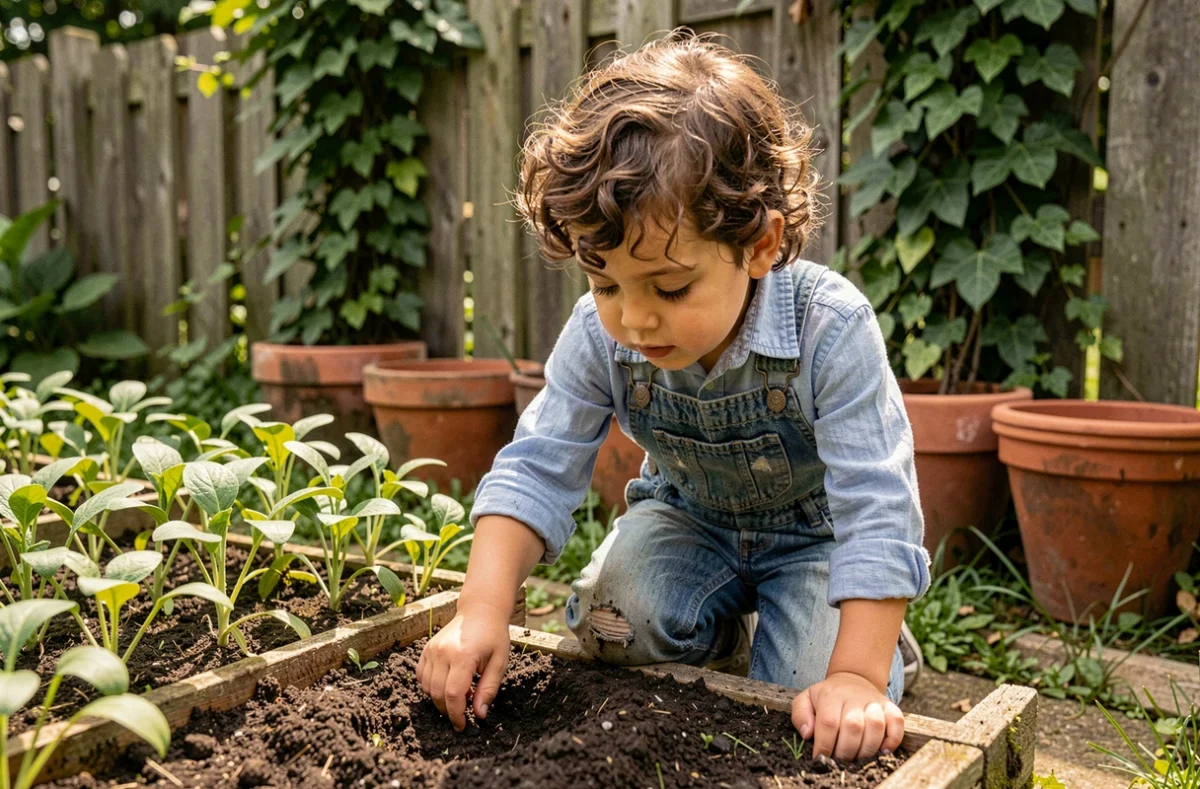
The story is divided into twenty chapters. Tistou, a little blond boy with wise curls, lives in a large house surrounded by gardens. Expelled from school for falling asleep in class, he is entrusted to the gardener Moustache, who teaches him about the plant world. It is there that he discovers his power: his thumbs make plants sprout instantly.
Each chapter confronts Tistou with a place of suffering. The prison, the hospital, the poor neighborhood, the battlefield. Each time, he places his thumbs on the ground, and flowers invade the space. The bars disappear under the ivy. The sick breathe better. The soldiers can no longer fight.
A Progression from the Personal to the Collective
The narrative moves from the family circle to society as a whole. Tistou begins by transforming the garden of the house, then acts on the city, and ultimately tries to change the world. This escalation gives the tale its philosophical dimension.
Nature becomes a tool of peaceful resistance. Druon does not propose violence against violence. He opposes plant growth to human destruction. The garden is not a backdrop; it is the character’s weapon.
- The prison: the flowers make the walls porous, and the inmates regain a sense of dignity through beauty.
- The hospital: the plants bring a soothing that medicine alone does not provide in the story.
- The battlefield: the cannons become blocked by vegetation, rendering war materially impossible.
- The poor neighborhood: misery recedes when the facades are covered in greenery and the inhabitants change their perspective on their environment.
Why Tistou the Green Thumbs is Still Read in Primary School
Having become a classic of children’s literature, the book serves as a basis for numerous educational projects in primary schools. Its strength lies in a simple mechanism: each chapter presents a social problem that the child can understand, then offers a symbolic response through flowers.
This framework allows teachers to work on text comprehension while opening up discussions. The tale connects reading, civic education, and ecological awareness within the same narrative. An eight-year-old child can discuss war or poverty without being overwhelmed, because the filter of the wonderful protects.
The comparison with The Little Prince by Saint-Exupéry often arises. Both books share a childlike character who questions the adult world. The difference lies in the action: Tistou does not just ask questions; he acts. His green thumbs are a concrete power, not just a contemplative stance.

Tistou Beyond the Book: Adaptations and Live Performance
The circulation of this work is no longer limited to the book and the classroom. Theater companies are programming adaptations of Tistou the Green Thumbs for young audiences, with several performances in various cultural venues.
Theater updates the critique of industrialization present in the tale. Tistou’s parents’ arms factory becomes, on stage, a symbol of ecological and social responsibility. Live performance extends the text by confronting it with contemporary concerns, particularly the climate emergency.
Some productions use paper theater and plant imagery to recreate the universe of the tale. The transformation of social injustices into a narrative of hope takes on a physical dimension when flowers actually appear on stage. This transition from book to stage shows that Druon’s tale functions as a living material, not as a school relic.
A Community Project Around Gardening
Cultural community projects also draw on the tale. Gardening becomes a factor of social change, faithful to the spirit of the text. Participants reread Druon through the lens of contemporary ecology, where the relationship between humans and plants no longer opposes nature and culture but explores their interdependence.
Tistou the Green Thumbs has traversed several decades without losing its relevance. The book says something enduring about the power to act against injustice, even when one is small, even when adults seem to have given up. Its reading remains a valuable entry point into engaged children’s literature.